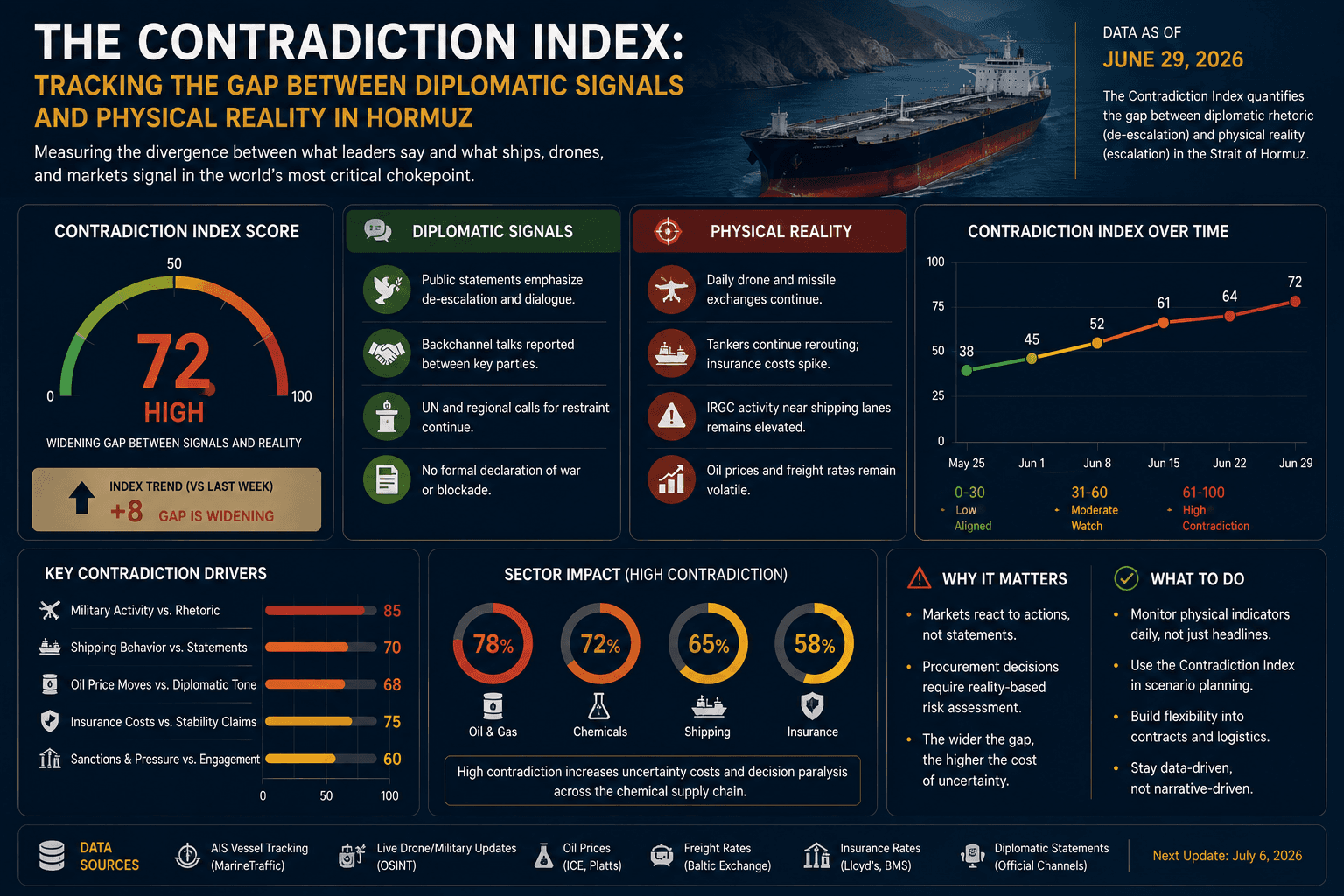
European petrochemical markets ended the week of June 16 to June 19, 2026 at their strongest levels of the year. The move followed the extension of the US-Iran ceasefire arrangement, which reduced immediate concerns about disruption around the Strait of Hormuz and improved sentiment across energy and petrochemical supply chains.
The rebound has been particularly significant because it followed one of the sharpest downturns seen earlier this year. European buyers of benzene, ethylene and propylene entered June after substantial price declines during May. The sudden reversal has created a market environment where procurement teams face both renewed cost pressure and unusually wide pricing gaps between related petrochemical products.
Why the Hormuz Ceasefire Extension Changed Market Sentiment
The Strait of Hormuz remains one of the most strategically important routes for global energy and petrochemical trade. Any threat to shipping activity immediately influences feedstock expectations, freight costs and supply availability.
The extension of the ceasefire reduced concerns about near-term disruptions. As a result, traders quickly adjusted risk premiums across multiple petrochemical chains.
Several factors contributed to the market reaction:
Market participants reduced the probability of supply interruptions from the Gulf region, improving confidence in future feedstock flows.
Energy markets stabilized, helping buyers reassess procurement plans that had been delayed during periods of uncertainty.
Trading activity increased as buyers returned to the market after waiting on geopolitical developments.
Benzene, Ethylene and Propylene Lead the Recovery
The strongest attention remains focused on benzene, ethylene and propylene because they sit at the center of numerous downstream value chains.
Benzene serves as a critical feedstock for styrene, phenol and various intermediates used throughout manufacturing. Meanwhile, ethylene and propylene remain essential building blocks for plastics, packaging, automotive components and consumer goods.
Recent market behavior has revealed several important trends:
Spot prices have recovered significantly from May lows.
Volatility has expanded beyond typical seasonal patterns.
Trading spreads between molecules have widened, creating challenges for companies that consume several feedstocks simultaneously.
For many procurement managers, the issue is no longer simply whether prices rise or fall. The larger concern involves how different molecules move relative to one another.
Unprecedented Price Spread Dynamics Across Petrochemical Chains
One of the most important developments in 2026 has been the extraordinary divergence between spot prices and historical averages.
Market participants report spread levels rarely observed in modern petrochemical trading. The cumulative deviation from annual mean pricing has approached extremes not seen since the economic turbulence experienced during 2008.
This creates several procurement challenges:
Budget forecasts become less reliable because historical pricing models lose predictive accuracy.
Contract negotiations become more difficult when suppliers and buyers hold different expectations regarding future market direction.
Inventory decisions carry greater risk because prices can shift sharply within short periods.
Companies accustomed to stable relationships between aromatics and olefins now face a market where traditional correlations have weakened.
Multi-Molecule Buyers Face Compounding Cost Pressure
Not every buyer experiences volatility in the same way. Companies purchasing a single feedstock can often manage risk through inventory adjustments or contract structures.
The situation becomes considerably more complex for businesses exposed to several interconnected molecules.
Consider manufacturers operating across:
Monoethylene glycol production chains.
Styrene and polystyrene value chains.
Polymer-grade ethylene consumption.
Propylene derivative manufacturing.
When costs rise simultaneously across multiple feedstocks, traditional hedging approaches often lose effectiveness. A strategy that protects exposure to one molecule may fail to offset losses elsewhere in the production chain.
This compounding effect has become one of the defining characteristics of the current European market environment.
Trade Flows and Supply Chain Implications
European petrochemical supply chains continue to balance regional production with imported volumes from the Middle East, Asia and North America.
The recent market rally has influenced buying behavior in several ways.
Some buyers accelerated purchases to secure material before further increases. Others adopted a more cautious approach, expecting volatility to continue through the remainder of the quarter.
Supply chain managers should pay close attention to:
Feedstock availability from major exporting regions.
Freight market movements affecting delivered costs.
Regional cracker operating rates.
Inventory positions across European distribution hubs.
Even when physical supply remains available, logistics disruptions can amplify price movements and create temporary shortages in specific locations.

How Buyers Are Responding to the New Market Environment
Procurement teams have shifted from purely price-focused strategies toward broader risk management frameworks.
Rather than attempting to predict exact market tops or bottoms, many organizations now focus on improving flexibility.
Common approaches include:
Diversifying supplier portfolios to reduce dependence on a single source.
Splitting purchases across multiple time periods rather than concentrating orders in one transaction.
Increasing market monitoring frequency during periods of elevated volatility.
Evaluating exposure across the entire value chain instead of managing each molecule independently.
The goal is not to eliminate risk completely. The objective is to prevent unexpected market movements from creating disproportionate financial impact.
What the Benzene Market Signals for Downstream Industries
Benzene often serves as an important indicator of broader petrochemical sentiment because of its central role in aromatics production.
A sustained recovery in benzene pricing can influence:
Styrene production economics.
Engineering plastics manufacturing.
Construction materials demand.
Automotive supply chains.
If benzene remains firm while downstream demand improves, buyers may face additional upward pressure in derivative markets during the second half of 2026.
However, demand recovery remains a key variable. Higher prices alone cannot sustain momentum unless end-user consumption supports the market.
Outlook for European Olefins Through 2027
The direction of ethylene and propylene markets will depend on a combination of geopolitical stability, energy costs and industrial demand.
Several scenarios remain possible.
A stable geopolitical environment could support gradual market normalization. Continued economic recovery across manufacturing sectors would reinforce demand growth and strengthen pricing.
Conversely, renewed geopolitical uncertainty or weaker industrial activity could introduce another round of volatility.
What appears increasingly clear is that the unusually large price swings experienced during 2026 have changed how market participants assess risk. Procurement decisions now require greater attention to cross-product exposure and supply chain resilience.
The Bottom Line for Procurement Teams
European petrochemical markets have entered a period where volatility itself has become a major commercial factor. The recent rally in benzene, ethylene and propylene demonstrates how quickly sentiment can shift when geopolitical risks evolve.
Procurement leaders should evaluate exposure across all connected feedstocks rather than viewing each molecule independently. Companies with positions in MEG, styrene, polymer-grade ethylene and related derivatives face a particularly challenging environment because cost pressures can emerge simultaneously across multiple chains.
Success in the months ahead will depend on disciplined sourcing, supplier diversification and continuous market monitoring. Ready to source benzene from verified global suppliers? Explore competitive offers on our platform today.
Styrene Monomer CAS: 100-42-5